
I spent twenty-eight years working in hotels and resorts, including 16 years at one of the world’s most respected luxury hospitality companies. I have hosted guests, shared meals, and helped set my fair share of tables.
And what I learned — slowly at first, then all at once — is that the table is not a piece of furniture. It is a threshold.
The Industry Taught Me the Mechanics. Pilgrimage Taught Me the Meaning.
In hospitality, we talk constantly about “the guest experience.” We measure it, train for it, and refine it across every touchpoint. But the most transformative moments I witnessed across nearly three decades rarely happened at the front desk or in the suite. They happened at the table. A widower having his first holiday meal in a year. Estranged siblings ordering wine after a hard conversation. Strangers becoming friends over a shared plate.
I started to suspect the table was doing something the rest of the building often couldn’t. It was walking pilgrimage routes — the Camino de Santiago, sections of the Via Francigena, the Pilgrims Way in England — that confirmed it.
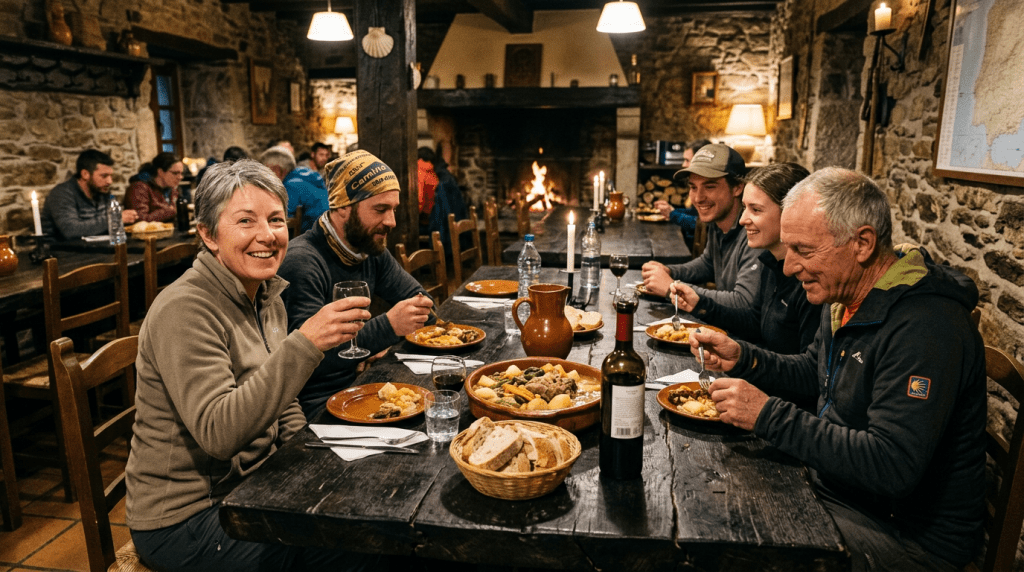
Through those experiences and hundreds of interviews with pilgrims for the Sacred Steps Podcast, I’ve seen and heard much the same thing: the destination matters. The cathedral, the relic, and the holy sites are all important landmarks on the journey. But ask them what changed them, and more often they’ll describe a meal (often with strangers) at a long table in a small village that they can’t quite locate on a map.
And I have experienced much the same myself. There is something unique about having a meal with your fellow pilgrims after a very long day of walking. Everyone is weary; no one is greater or lesser. Often there are three or more languages being spoken and yet we still understand: I have something to share; I have something to learn. Moments like these are the core memories of pilgrimage for many.
📖 About The Pilgrim’s Table
Hospitality is the novel’s central character. Six pilgrims, one inn, one communal dinner served by the chef — and the discovery that the journey’s deepest revelations arrive between courses.
Kindle presale available now. Available this summer in hardcover and paperback at retail bookstores. Book club orders and signed copies at thepilgrimstable.com.
A Theology of the Table
Christian tradition has always known this. The Rule of Saint Benedict — written in the 6th century and still shaping monastic hospitality today — commands that every guest be welcomed “as Christ himself.” Not as a customer. Not even as a friend. As Christ.
The early Church grew not through buildings but through tables. The Eucharist itself is a meal. And the Letter to the Hebrews reminds readers that some have entertained angels without knowing it — a line that, after enough miles on foot, stops feeling metaphorical.
And this is not exclusively a Christian tradition. In fact, the commandment to care for the stranger predates Christianity by hundreds of years in the Jewish and Muslim texts, and by thousands of years in Sikh, Buddhist, and Hindu texts. In fact, one of the most famous teachings in all of Hinduism is “Atithi Devo Bhava” (the guest is God.)
What the Modern Hospitality Industry Gets Right (and What It Misses)
The hospitality industry has perfected the mechanics of welcome. What it has not yet learned — what perhaps it cannot learn within a profit model — is that hospitality, at its deepest, is not transactional. It is reciprocal. The host is changed by the guest. The guest is changed by the host. Something passes between them that neither one owned alone.
That’s the territory The Pilgrim’s Table explores. Six strangers. One table. A pilgrimage that turns out to be less about the destination than the moments that define it.
The Pilgrim’s Table releases July 1, 2026. Presale is available now for Amazon Kindle and Kindle Unlimited. Order signed copies or join the book club community at thepilgrimstable.com.
#ThePilgrimsTable #SacredHospitality #TableFellowship #PilgrimageLife #FaithAndCommunity #ChristianFiction
